SIGN-UP for free to access many grassroots activist resources and training materials.
Forward this newsletter to your friends. Post excerpts on social media.
Help TCC pass Trump’s legislation & confirm nominees! DONATE HERE!
Bypassing the Filibuster
The Senate Democrats refused to reopen the government for 43 days—setting a new record. That left millions temporarily without food assistance and air travel was highly disrupted. During that time, President Trump’s staff couldn’t work during this time to uncover more waste, fraud and abuse.
President Trump has asked the Senate to scrap the filibuster that awards Democrats an effective veto of Trump’s agenda.
There’s excellent arguments for doing so, as well as cautions against.
The word ‘filibuster’ is derived from the Dutch term for ‘pirate;’ ‘a plunderer who operated outside legal authority for personal gain.’
First, let’s review the current use of a filibuster. While a bill must have a simple majority of votes to pass, 51 when all 100 members are present, the current Senate rules allow a minority of 40 Senators to hold up a vote by
The Strategy
However the Senate can actually pass budget and other key bills using existing rules and without scrapping the filibuster.
Here’s the step-by-step mechanism in ‘Senate-ese,’ then I’ll translate it into English.
First, convene the Senate and make sure at least 51 Republicans are on the floor. Then initiate a quorum call (Rule VI) to lock in attendance. Call up the bill using Unanimous Consent or a Motion to Proceed. Then put the question for an immediate vote, file daily clotures (deliberately failing 51-49) to enforce Rule XIX’s two-speech cap and Rule XXII’s time limits (~60 hours total). Then hold quorum calls and outlast their speaking filibuster until the floor yields for at least 51-49 passage.
That sounds incredibly technical, and it is. The Senate’s rules are complex and some are almost as old as the republic, but those who master them can often succeed against powerful opposition.
Now, here’s the plain English of the above;
How the Senate can avoid eliminating the filibuster, yet get bills the Democrats absolutely hate passed in a reasonable length of time.
Summon at least 51 Republicans in the Senate chamber. Then ask for a “quorum call” under “Rule VI.” That’s the basic rule that says you need at least 51 senators present—like a headcount—to do any work. If any Senators are missing, they would be summoned to arrive rapidly. Once the Republican majority is present, the “quorum” number is achieved, and the action begins.
This is guaranteed to infuriate the Democrats, but they wouldn’t be able to do anything about it.
The Majority Leader or his designee would then put the bill on the table and call for a vote right away. With the majority of at least 51 Republicans confirmed, bring up the bill using “unanimous consent” (everyone agrees quickly without a roll call vote) or a “motion to proceed” (a formal request to start discussing the bill). Then, the leader or a designee states “I put the question.” That means “let’s vote yes-or-no on this bill now with no more discussion.”
The next step would block endless debating using daily vote tricks: Democrats will try to stall by giving long speeches (a “filibuster” in the original sense of actually talking for hours without a break. That could include reading long books just to waste time).
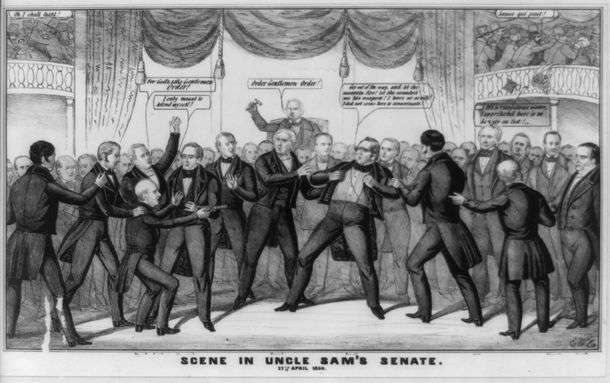
“Scene in Uncle Sam’s Senate” — April 1850
To speed this up, Republicans would file a “cloture petition” every day under “Rule XXII” (the main rule for ending filibusters: 16 senators must sign it to trigger a vote after one or two days. That needs 60 yes-votes to stop debate, but it’ll fail by 51-49 here because Republicans will be instructed to vote ‘No.’
Each failed vote kicks in time limits from “Rule XIX” (the debate rule that lets each senator speak only twice per “legislative day.” In this case, the “legislative day” lasts the entire time of this in-person filibuster, no matter how many actual days it spans.
The “Rule XIX” caps speeches in length to avoid chaos. After those deliberate failures, “Rule XXII” is used to add strict timers: which could be two hours maximum per Senator.
What all this does is to turn the current unlimited-length filibuster into an old fashioned “talking” filibuster limited to about 60 hours from start to stop.
During this time, a Republican majority of at least 51 members must remain in the Senate chamber at all times.
The leader would continue to do periodic ‘quorum calls’ to assure all Republicans are present (back to “Rule VI”).
With all 53 Republican Senators present, there’s enough to let a couple Senators at a time to take bathroom breaks and have a snack in the adjacent ‘cloakroom.’
Senate Democrats will tag-team speeches to delay everything, but they’ll eventually tire out under the time caps. Once they “yield the floor” (give up and stop talking), the leader in the chair calls for the final vote.
Republicans will then vote yes, and the Democrats will vote no. The bill will thereby pass by a simple majority vote.
No 60-vote hurdle needed for approval. Done.
The bill would then be sent to President Trump to sign, or if the House hadn’t yet voted on it, it would be delivered to the House for their simple majority vote.
That’s the complicated but actually pretty simple way to pass a bill that the Democrats oppose (really most everything of substance these days) without permanently ending the filibuster.
This tactic could not be used on everything because it would require the Senate to spend the better part of a week to pass just one bill this way.
And that week would be incredibly strenuous because all Senators would have to spend several days and nights on the Senate floor. That could be done several times per year, if the Republican leadership is brave enough.
Just End It?
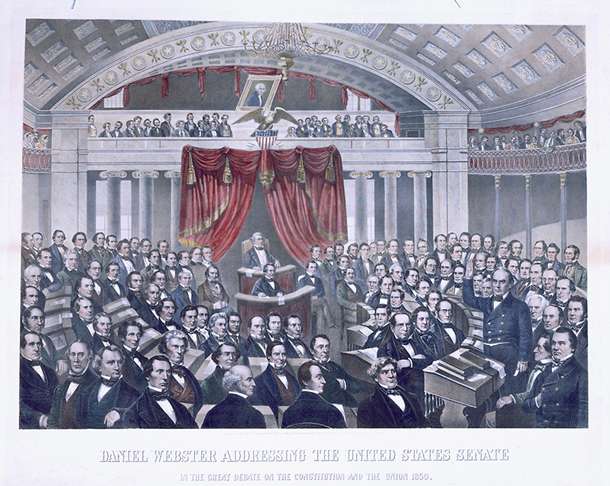
Daniel Webster Addressing the United States Senate
Wouldn’t it be easier to just end the filibuster? Let the Republican majority pass everything to enact our conservative agenda without requiring seven Democrats to somehow agree?
The reasons include disturbing two centuries of the filibuster, including the past 50 years of the unlimited-time ‘silent’ filibuster, plus worries that the Democrats would use the absence of the filibuster to pass their most radical agenda whenever they may regain the majority (though they would do so regardless).
Here’s the practical reason though. In spite of President Trump supporting the repeal of the filibuster, there’s too many Republican Senators oppose ending the filibuster.
So, we urge the Republican leadership in the Senate to adopt this procedure and pass the key elements of President Trump’s agenda.
The Conservative Caucus has been fighting for constitutional principles since 1974. Your donation helps us continue bringing you the truth the mainstream media won’t report.
About The Conservative Caucus: Founded in 1974, The Conservative Caucus is a grassroots public policy action organization dedicated to preserving American sovereignty, constitutional liberties, and traditional values. Under the leadership of President Jim Pfaff, TCC continues to fight for the principles that made America great.
This analysis is from The Goldwater-Thomas Report, a publication of The Conservative Caucus. Publisher: Barry Goldwater Jr. • Chairman: Peter J. Thomas • Editor: Art Harman
DONATE TO THE CONSERVATIVE CAUCUS AND HELP US TAKE BACK OUR COUNTRY.
Our mission is to create a grassroots conservative network, uniting people of widely varying backgrounds in peaceable defense of our country, our Constitution, and our common values rooted in liberty and equal rights.
Your donation to The Conservative Caucus is more than a financial contribution. It’s a stand for the principles that have made our nation great: liberty, prosperity, and the rule of law. When you give, you’re not just supporting an organization. You’re supporting a return to the foundational ideals that have guided our country from the very beginning.
Our goal at The Conservative Caucus is to champion these timeless principles in the policy arena and beyond. But we can’t do it without you. Your generous donation allows us to continue our vital work – influencing policy, holding lawmakers accountable, advocating for fiscal responsibility, and fighting to preserve the constitutional freedoms that underpin our great nation.
The road ahead may be challenging, but together, we can reclaim the vision our Founding Fathers had for America. Whether it’s a one-time gift or a recurring monthly contribution, your donation makes a real, tangible difference. Stand with us today. Help us take back our country. Your support could be the very thing that tips the balance in favor of a brighter, stronger, more conservative future for America.
Thank you for your unwavering commitment to our cause. Together, we will make a difference.
JOIN TCC IN STOPPING THE ATTACKS ON OUR FREEDOM.
If the liberals have their way, our speech will no longer be free, our guns will become outlawed, and every other right we cherish will be endangered. Let your voice be heard and tell our government to uphold the Constitution, and continue to keep America the land of the free and the home of the brave.
THE PLEDGE:
I join the overwhelming majority of conservative Americans to demand that the government no longer violate our Constitutional rights.
I stand with all Americans and affirm our Constitutional rights and urge all candidates and elected officials to affirm the same.
Mr. Peter J. Thomas
Chairman
Peter J. Thomas is a veteran conservative political strategist and seasoned policy expert dedicated to upholding the principles of the Constitution and democracy. As a founder and the chairman of the Conservative Caucus, he has played a pivotal role in promoting and shaping the conservative agenda across the nation for over half a century.
Peter’s distinguished career includes key presidential appointments under Presidents Reagan, Bush Sr., and Bush Jr. Under President Reagan, he served as the New England Regional Administrator of the General Services Administration. During Bush Sr.’s administration, he was the Special Assistant to the Secretary of Small Business. Under Bush Jr., he rose to the position of Acting Assistant Secretary for Administration in the Department of Agriculture. Additionally, Peter gained invaluable insight into Congress as Chief of Staff to Rep. Peter Torkildsen (R-MA).
Peter’s dedication to conservative values is further demonstrated by his tenure as the National Field Director of TCC in its early years, when he oversaw chapters in most congressional districts. His diverse experience also includes, founding and presiding over the Massachusetts Foundation for Economic Research, serving as director of communications for Papa Gino’s restaurants, and earning accolades as a leading sales representative for State Mutual of America.








 Peter J. Thomas is a veteran conservative political strategist and seasoned policy expert dedicated to upholding the principles of the Constitution and democracy. As a founder and the chairman of the Conservative Caucus, he has played a pivotal role in promoting and shaping the conservative agenda across the nation for over half a century.